

In today’s digital business environment, cloud performance directly affects operational efficiency, application responsiveness, and customer experience. For organizations running business-critical workloads, even minor performance issues can lead to delays, reduced productivity, and disruptions to essential business operations.
As businesses increasingly rely on cloud infrastructure to support enterprise applications, databases, digital services, and AI-driven workloads, optimizing cloud performance has become a strategic priority.
But cloud performance optimization is not simply about increasing computing resources. It requires a balanced approach to resource allocation, workload management, network performance, monitoring, and infrastructure scalability.
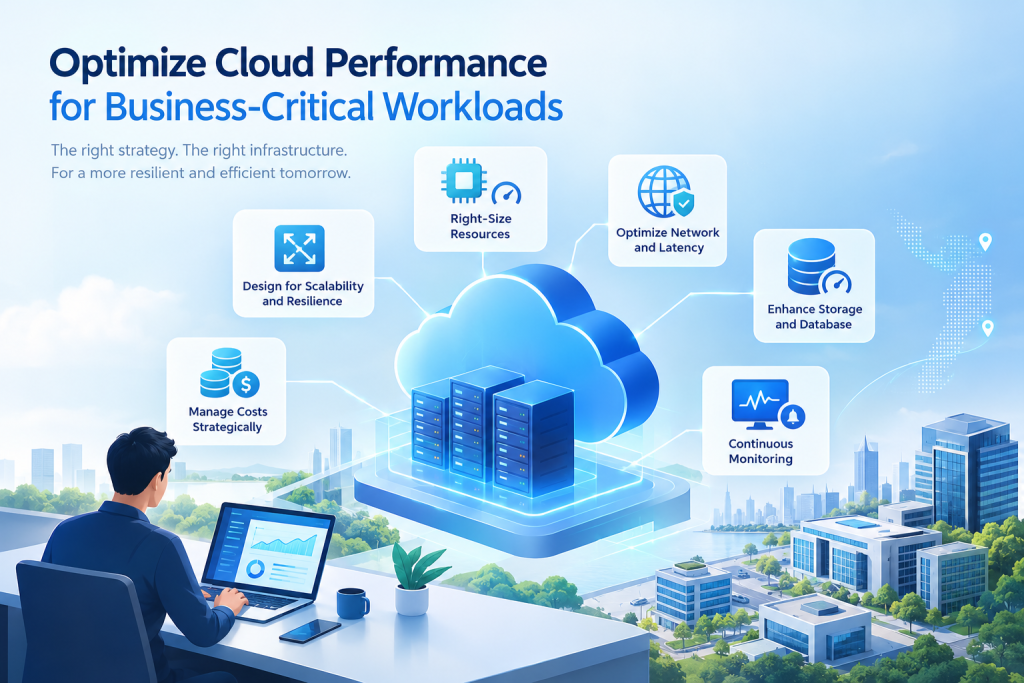
Here are six practical strategies businesses can implement to optimize cloud performance for business-critical workloads.
1. Right-Size Cloud Resources Based on Workload Requirements
One of the most common cloud performance challenges is resource misallocation. Applications may experience performance bottlenecks when computing resources are insufficient, while overprovisioned infrastructure can increase costs without delivering meaningful performance improvements.
To address this challenge, businesses should regularly evaluate CPU utilization, memory consumption, storage performance, and application resource requirements.
Cloud resource optimization involves:
- Matching virtual machine specifications to actual workload demands.
- Identifying underutilized or overutilized instances.
- Adjusting resource allocation based on application performance requirements.
- Reviewing resource consumption as workloads evolve.
For business-critical applications, resource allocation should account for both normal operating conditions and periods of peak demand.
The goal is to maintain consistent application performance while using cloud resources efficiently.
2. Optimize Network Connectivity and Latency
Computing power alone cannot guarantee optimal cloud performance. Network latency, bandwidth limitations, and inefficient data paths can significantly affect application responsiveness, particularly for distributed applications and systems that exchange large volumes of data.
This is especially important for businesses operating across multiple locations or connecting cloud environments with on-premises infrastructure.
To improve network performance, organizations should consider:
- Selecting cloud infrastructure locations closer to users, applications, and data sources.
- Evaluating network latency, bandwidth, and packet loss.
- Optimizing connectivity between cloud environments, offices, and data centers.
- Minimizing unnecessary data transfers between systems.
- Reviewing network architecture to identify potential bottlenecks.
For workloads that depend on real-time data exchange or frequent database queries, even small reductions in network latency can contribute to a better user experience.
Reliable connectivity should therefore be treated as a core component of cloud performance optimization, rather than a separate infrastructure consideration.
3. Improve Storage and Database Performance
Storage performance can become a significant bottleneck when applications depend on frequent read and write operations, large datasets, or high transaction volumes.
Business-critical workloads such as enterprise resource planning (ERP), customer relationship management (CRM), analytics platforms, and transactional databases require storage configurations that match their performance requirements.
Businesses can improve storage and database performance by:
- Selecting storage options appropriate for workload latency and throughput requirements.
- Monitoring input/output operations per second (IOPS) and storage latency.
- Optimizing database queries and indexing strategies.
- Reviewing caching mechanisms to reduce repeated data access.
- Separating workloads with significantly different storage requirements when appropriate.
It is also important to identify whether performance issues originate from storage, database queries, application logic, or network connectivity before increasing infrastructure capacity.
A systematic approach helps organizations resolve the actual source of performance bottlenecks instead of investing in resources that may not address the underlying problem.
4. Implement Continuous Performance Monitoring
Cloud environments are dynamic. Workload patterns change as user activity increases, applications evolve, and new services are introduced.
Without continuous monitoring, performance degradation may remain undetected until users experience slow applications or critical business processes are affected.
Effective cloud performance monitoring should cover several key metrics:
- CPU and memory utilization: Identifies resource pressure and capacity constraints.
- Application response time: Measures how quickly applications respond to requests.
- Network latency and packet loss: Helps identify connectivity issues.
- Storage latency and IOPS: Reveals potential storage bottlenecks.
- Error rates and availability: Highlights service degradation and application failures.
Organizations should establish performance baselines and define alerts for metrics that indicate potential problems. Monitoring should also include application-level indicators, not just infrastructure metrics.
For business-critical workloads, teams should define clear performance objectives and escalation procedures so they can respond before an issue significantly affects business operations.
5. Design for Scalability and Resilience
Business demand rarely remains constant. Seasonal traffic, product launches, reporting cycles, and transaction spikes can increase infrastructure requirements within a short period.
Cloud infrastructure should be designed to accommodate these changes without compromising application performance.
Depending on the workload architecture, businesses can improve scalability and resilience through:
- Vertical scaling to increase the capacity of existing compute resources.
- Horizontal scaling to distribute workloads across multiple instances.
- Load balancing to distribute incoming traffic efficiently.
- Redundant infrastructure components to reduce single points of failure.
- Backup and disaster recovery strategies to support business continuity.
Scalability and resilience address different but complementary needs. Scalability helps applications handle changing demand, while resilience helps systems continue operating or recover when components fail.
Not every application requires the same architecture. The appropriate approach depends on business impact, recovery requirements, application dependencies, and budget.
For business-critical workloads, these requirements should be established before performance issues occur, rather than addressed only after an incident.
6. Align Performance Optimization with Cost Efficiency
Improving cloud performance does not necessarily mean increasing spending. In many cases, businesses can achieve better results by identifying inefficiencies and allocating resources more strategically.
However, cost reduction should not come at the expense of application performance or reliability.
A practical cloud optimization strategy should include:
- Reviewing infrastructure utilization and spending regularly.
- Identifying idle or oversized resources.
- Matching service configurations to workload priorities.
- Evaluating the cost implications of scaling and redundancy.
- Tracking performance improvements alongside infrastructure costs.
Businesses should also distinguish between workloads that require consistently high performance and those that can tolerate flexible resource allocation.
This approach enables organizations to prioritize spending where it delivers the greatest operational value while maintaining the performance standards required by critical applications.
A Practical Framework for Cloud Performance Optimization
Cloud performance optimization is most effective when treated as an ongoing process rather than a one-time infrastructure adjustment.
A practical framework includes four stages:
1. Assess: Establish performance baselines, review resource utilization, and identify bottlenecks.
2. Optimize: Adjust compute, storage, network connectivity, and application configurations based on measurable findings.
3. Monitor: Track performance indicators continuously and configure alerts for potential issues.
4. Improve: Review workload trends, evaluate results, and refine infrastructure configurations as business requirements change.
This continuous improvement cycle helps organizations maintain performance as their applications, user demands, and infrastructure requirements evolve.
How OMNI Cloud Supports Business-Critical Workloads
Optimizing cloud performance requires infrastructure that aligns with application requirements, business priorities, and connectivity needs.
OMNI Cloud provides cloud infrastructure solutions designed to support businesses with flexible computing resources and connectivity options. Depending on workload requirements, organizations can evaluate solutions such as virtual machines, bare metal infrastructure, GPU compute, and cloud connectivity services.
These options can help businesses build infrastructure environments suited to enterprise applications, data-intensive processing, and emerging AI workloads.
With infrastructure requirements assessed against performance, scalability, and connectivity needs, businesses can make more informed decisions about how to deploy and optimize their critical workloads.
Every workload has different requirements. The right cloud strategy begins with understanding those requirements and selecting an infrastructure configuration that supports them.
Conclusion
Cloud performance optimization is essential for businesses that depend on reliable, responsive, and scalable digital services. By right-sizing resources, improving network connectivity, optimizing storage, implementing continuous monitoring, designing for resilience, and managing costs strategically, organizations can build a stronger foundation for business-critical workloads.
The key is to measure performance continuously and make infrastructure decisions based on actual workload behavior rather than assumptions.
Looking to optimize your cloud infrastructure for business-critical workloads?
Contact OMNI Cloud to discuss your infrastructure requirements and explore cloud solutions tailored to your business needs.
Visit www.omnicloud.co.id or email sales@omnicloud.co.id to get started.